After a lifetime fishing on Lake Okeechobee, Justin Jones has gotten familiar with the herbicides state contractors spray on the water to kill invasive aquatic plants like hydrilla and water hyacinth.
“Some taste like metal, like pennies in the air,” Jones said of chemicals with names like Glyphosate, Diquat and Aquathol Super K. “Others smell like a really bad cleaning chemical.”
Jones, a 36-year-old bass fishing guide who has fished this lake since he was 6, says he regularly shares the water with spray boats hired by the Florida Fish and Wildlife Conservation Commission (FWC). Wherever the boats spray herbicides, Jones said, mats of dead, brown vegetation sink to the bottom and decay, forming a thick layer of muck that carpets the normally clear, sandy lakebed.
Scientists say the rotting plants release pulses of nitrogen and phosphorus that — combined with nutrient pollution from fertilizer and leaky septic tanks — can fuel toxic algae blooms, lower oxygen levels and kill fish.
Jones blames the herbicides for “decimating” the lake, thinning the bass population and tanking his business.
“They’re spraying this place to death,” Jones said. “I’m working less and less, and I’m honestly wanting to quit guiding because it’s really not fun being out there working and watching them spray all around you.”
The state’s herbicide spraying has sparked fierce public backlash and a recent round of promises from FWC commissioners to reform the way the agency manages invasive aquatic plants. Florida’s largest lake may be the test case for a new strategy.
But state officials are starting to form that strategy in secret.
FWC has created a new body, dubbed the “Lake Okeechobee Coordinating Council,” which holds closed-door meetings — without public notice or published minutes — to consult with state and federal agencies, tribal nations and representatives from special interest groups including the CEO of Bass Pro Shops and a lobbyist for duck hunters. Their goal is to “develop a common vision for aquatic plant management,” according to a draft charter document obtained by the Trib.
The council is “going to be really the lead on helping craft ideas” and “start to develop sustainable solutions for aquatic vegetation management across Lake Okeechobee and beyond,” FWC commissioner Joshua Kellam said during a Feb. 5 public meeting.
Although Kellam has described the council as a source of “long-term solutions” for aquatic plant management that will “last for generations to come” and influence FWC’s strategy not just in Lake Okeechobee but across the state, the council’s meetings aren’t open to the public. The FWC says the council isn’t subject to Florida’s Sunshine Law, which strictly requires government and advisory bodies to meet in public with very few exceptions. Two Sunshine Law experts who spoke with The Florida Trib were skeptical of FWC’s position.
The council held its first private meeting at South Florida Water Management District Headquarters on June 25. It will meet again behind closed doors on Sept. 22 and 23 at the Seminole Brighton Bay Hotel in Okeechobee.
“The Coordinating Council is not subject to Florida’s Sunshine Law, but will operate in accordance with all applicable public meeting and transparency requirements,” FWC spokesperson Ryan Sheets wrote in an email. “The Council is a fact-finding body without policy or decision-making authority, and it does not make recommendations.”
Whether or not a court would agree that the council falls under a narrow exception to Florida’s transparency laws, public bodies are better off meeting in the open, according to David Cuillier, director of the Joseph L. Brechner Freedom of Information Project at the University of Florida.
“It’s just good public policy to operate transparently when you are formulating conclusions or recommendations that could be enacted that affect everyday Floridians,” said Cuillier. “That’s why the law is there.”
FWC did not dispute or confirm the descriptions of internal council documents the Florida Trib obtained that are described in this story. When asked, Sheets suggested the Trib submit a formal public records request, which is still pending.
“Council updates will be forthcoming and made available on MyFWC.com. We can alert you when the information is published in the coming weeks,” he wrote in an email.
Closed-door council
The first meeting of the Lake Okeechobee Coordinating Council on June 25th included representatives from FWC, the Army Corps, the South Florida Water Management District, the Seminole and Miccosukee tribes and Zachary Hartman, chief policy officer for Ducks Unlimited, a nonprofit that represents duck hunters and pushes for wetland conservation.
The council also has a seat for Bass Pro Shops CEO Johnny Morris, although he didn’t attend the first meeting. Bass Pro Shops is planning to build a resort on Lake Okeechobee, pending permits from the state and Army Corps for water and sewer lines in the Okee-Tantie Recreation Area. There is also a seat for an environmentalist representing the interests of “non-game birds,” but it has not been filled.
The only published record of the June 25 meeting is a brief summary that FWC executive director Roger Young gave at the start of a public FWC commission hearing on Aug. 5.
“The first meeting focused on providing a shared understanding of the council’s purpose and responsibilities, reviewing current lake conditions and management activities and identifying priorities for future decisions,” Young said.
“It was nice to see all the stakeholders sitting around the table actually talking about the implementation of action items,” added Kellam, the FWC commissioner who spoke at earlier hearings about the council bringing forward ideas that would shape Florida policy for generations.
According to a draft agenda for the June meeting obtained by the Trib, attendees also planned to discuss whether they needed to tell Floridians what they were up to.
One bullet point for discussion reads: “Council will not be subject to Sunshine requirements (?)”
Judges have weighed in on that question over decades of court cases. Florida’s Sunshine Law is extremely broad and applies even to “advisory boards whose powers are limited to making recommendations to a public agency and that possess no authority to bind that agency in any way,” according to a 2010 advisory letter from the Florida attorney general’s office.
The law has a carve-out for government bodies whose only job is “fact-finding,” which the attorney general’s office described as “strictly information gathering and reporting,” but not “sorting through options and making recommendations to the governmental body.”
The draft charter document for the Lake Okeechobee Coordinating Council directs the group to undertake “fact-finding to reach conclusions on priorities, positions and potential policies or actions for the management of Lake Okeechobee with a focus on aquatic plant management” and build “high-level joint support for management actions.”
It also says the Aquatic Plant Management Interagency Task Force — a group of state and federal officials and university researchers who meet to coordinate Florida’s invasive aquatic plant strategy — “will take into consideration the fact-finding conclusions from the Council when considering management options.”
Catherine Cameron, a law professor at Stetson University who studies public records laws and practiced in Florida, is skeptical that the Lake Okeechobee Coordinating Council falls under the fact-finding exception to the Sunshine Law.
“That means you’re literally just a conduit of raw data to another body that’s going to deliberate and talk about it,” she said. “But it sounds like these folks are discussing it. Even if they can’t make the official act, they’re making recommendations to a body that can put the official act in place, and under the case law and the statute, that would make them subject to the open meetings laws.”
It’s not just an academic debate. If the closed-door council makes recommendations that influence FWC’s herbicide tactics or policies, courts could strike down the changes.
“Should action be taken in violation of the Sunshine Law, it is considered void,” the Florida attorney general’s office wrote. “Only a full open hearing will cure a violation of holding a meeting outside the Sunshine Law.”
An endless fight against weeds
The council’s conclusions may play an important role in the next chapter of Florida’s never-ending battle against invasive aquatic plants.
The state is flat, sprawling and wet — covered with more than 12,000 square miles of lakes, rivers, canals, springs, ponds and water reservoirs that stay warm year-round. It’s a hub for trade and tourism, giving sprouts and seeds from around the world plenty of opportunities to hitch a ride. And pollution from fertilizer and sewage has flooded waterways with nutrients that fuel explosive plant growth.
“Everything comes together for aquatic plants to absolutely thrive and proliferate in Florida,” said Stephen Enloe, a professor of weed science and invasive plants at the University of Florida.
Invaders have been marching across the state for centuries. Florida gardeners brought home water hyacinth, an Amazonian ornamental prized for its pretty purple flowers, from the 1884 World’s Industrial and Cotton Exposition in New Orleans. Aquarium dealers introduced a stringy pest called hydrilla into Florida canals in the 1950s.
Over time, these plants grew out of control and caused headaches for Floridians and local ecosystems.
“If we do nothing, we’ve learned the hard way that many of these invasive plants will literally take over our water systems,” said Enloe. “They will clog our canals and reduce water flow so that you get flooding.”
Water hyacinth in particular grew so thick around the turn of the 20th century that it blocked steamboat traffic on the St. John’s River. So, the Army Corps of Engineers — already deep into its quest to drain the Everglades and conquer nature — went to war with aquatic plants.
Early water managers showed little mercy for invasive plants or any other living thing in the general vicinity of a navigable river. In 1902, spray boats coated the St. Johns River with a mixture of arsenic and saltpeter. The poison got rid of the water hyacinth, but it also killed cows grazing by the river and raised such a ruckus from cattlemen that it was quickly banned.
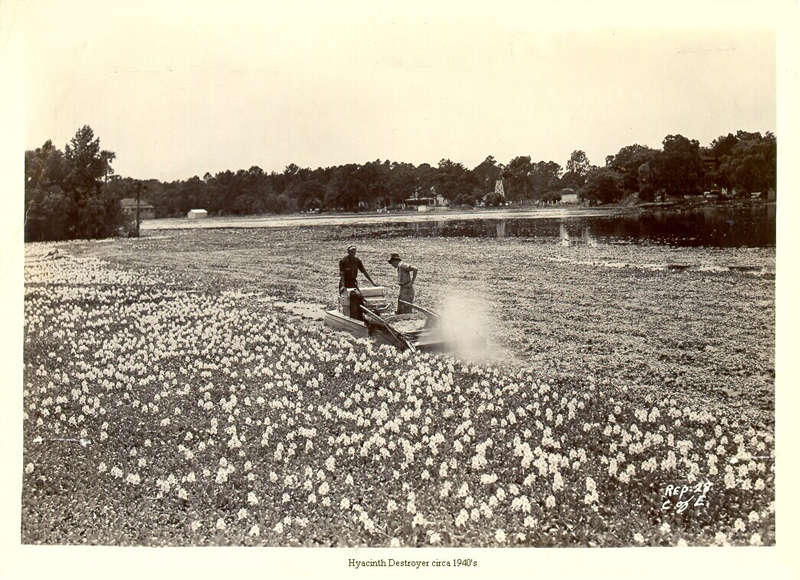
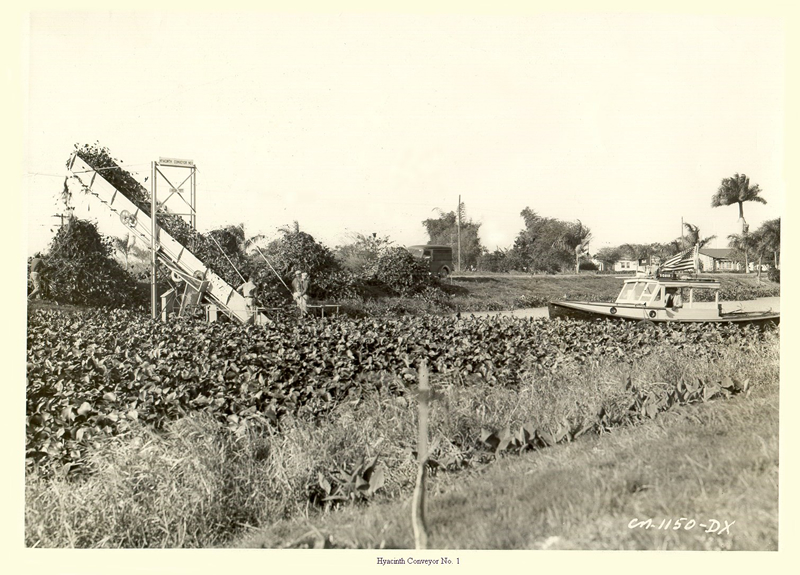
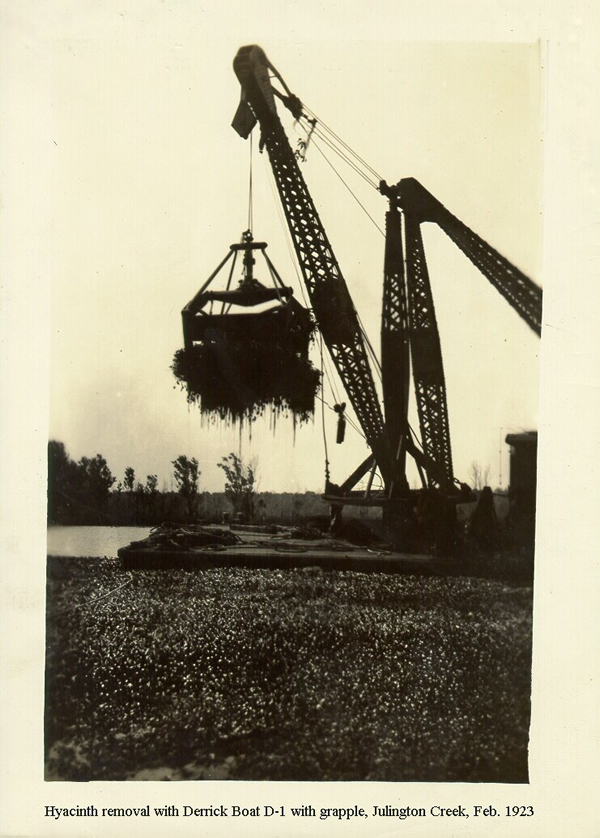
The Army Corps switched to new chemical controls and also deployed a small armada of crusher boats, “hyacinth destroyers,” conveyor belts and cranes to mechanically pull plants out of the water. In 1910, Congress even debated a bill to introduce hungry hippos into Florida’s waterways to eat hyacinth (and become a source of exotic meat branded “low cow bacon”), but lawmakers ultimately thought better of it.
Around World War II, advances in chemical research yielded new herbicides with fewer obvious side effects. Over time, herbicides won out over mechanical harvesting and biological controls (e.g. releasing plant-eating insects or fish) as the cheapest, most effective way to kill masses of fast-growing plants. Today, water managers — primarily the FWC, but also the Army Corps, water management districts, local governments and homeowners associations — spray chemical herbicides over tens of thousands of acres of lakes, rivers, ponds and reservoirs each year.
They operate under a strategy called “proactive management”: Spray aquatic weeds into submission, then send spray boats on patrols to kill any stubborn survivors before they spread. Enloe said eradicating established weeds is impossible. So, this approach allows water managers to keep invasive plants in check and, in the long run, use less herbicide on small patches of remaining vegetation.
Enloe added that herbicides have improved over time. Scientists have developed new chemicals marketed to target particular species and break down in the water within days or weeks.
“We tried a lot of things. We sprayed a lot of really toxic stuff. We made a lot of mistakes early on,” said Enloe. But since then, “we have come a long, long way.”
Public fury
Not everyone is satisfied with that story of progress.
A very vocal group of Floridians vent their anger over the state’s herbicide use in Facebook groups with names like “Aquatic Plant Management Is Killing Our Waterways.” Dozens of dedicated activists turn up at public meetings to air their grievances.
Jim Watt, a 72-year-old retired reptile dealer and turtle farmer, said he got involved nine years ago after FWC sprayed two of his favorite spots to catch green anoles on Lake Okeechobee and the St. Johns River.
“They killed all the lizards, green snakes, ribbon snakes, all the insects and everything almost overnight,” Watt said. Ever since, he’s been digging through FWC records and accusing the agency of financial impropriety and breaking federal rules about where and how to apply herbicides.
Eric Cassels, who runs a bait shop on Lochloosa Lake, started posting videos on Facebook eight years ago that he said document the environmental consequences of herbicide spraying, including rancid muck, fish kills, and water coated with chemical films or gooey gels designed to slowly release herbicide. He worries about the well water he drinks and the invertebrates he catches and sells to fishermen.
“The shrimp can’t stand the poison,” Cassels said. “The other day I found a whole shoreline of dead shrimp, and I’ve never found that before, ever, in my whole life.”
While some of the herbicides’ federal labels say they can be toxic to invertebrates in high doses, scientists haven’t published studies showing that the chemicals are directly killing animals in Florida’s waterways.
But there is scientific evidence that herbicides can cause big clumps of dead plants to rot all at once, releasing bursts of nutrients into the water that fuel algae blooms. The process can turn naturally clear water into murky, low-oxygen environments.
“A high percentage of freshwater fish kills in Florida are caused by low oxygen conditions, and many times those low oxygen conditions shortly follow an aquatic herbicide treatment,” said James Douglass, a professor of marine science at Florida Gulf Coast University. “It’s not at all uncommon for a fish kill to follow an herbicide treatment.”
Douglass said officials should consider replacing some chemical spraying with mechanical harvesting, which removes nutrients from waterways. He argues the water quality benefits outweigh the higher cost.
Meanwhile, bass fishermen tend to prefer that water managers leave some aquatic plants like hydrilla in lakes to provide habitat for baby bass. Similarly, duck hunters like hydrilla because it attracts ducks. They lobby officials to spray less in popular hunting and fishing areas.
Water managers have occasionally tried to placate their critics. Since 2011, FWC’s official position has been that it will consider “sportfish growth,” “recreational use” and “stakeholder input” among other factors when managing hydrilla, which has sometimes meant letting the plant grow a little more on lakes popular with bass fishermen or during duck hunting season.
In 1986 and 2019, officials paused their use of chemical herbicides and relied solely on mechanical harvesters. A report from the UN’s Food and Agriculture Organization recorded that the 1986 policy “had considerable negative consequences” in Lake Okeechobee.

Within six months, water hyacinth cover quadrupled, “obstructing most of the boat trails and canals, as well as the 22 flood control and navigation structures,” the authors wrote. “The herbicide program was resumed immediately to restore order but not before thousands of acres of native vegetation, beneficial to fisheries and waterfowl, were smothered or uprooted by floating mats of water hyacinth.”
It took two years, $2 million and much more herbicide to get the lake back under control, according to a University of Florida summary.
Enloe — who stressed that he doesn’t speak for the FWC — said the agency is “between a rock and a hard place.”
“They’re making some people happy, and then making other people angry,” he said. “They can’t please everybody.”
Lately, the controversy around herbicides has become even more heated. Some online commenters have made death threats against spray boat operators.
“I would wait for that boat to come ashore and I would [beat] each person to death with a baseball bat,” one commenter wrote.
Meanwhile, FWC officials were caught using law enforcement records to track agency critics, including Jim Watt. State employees searched Watt’s records 34 times.
“I actually fear for my life,” Watt said.
In this charged environment, public officials and special interest groups on the Lake Okeechobee Coordinating Council began meeting in private to chart a new course for Florida’s herbicide strategy.
“I think a lot of public bodies would like to be able to meet secretly because then they feel they can speak more freely,” said Cuillier of the University of Florida’s Freedom of Information Project. “It is not easy or fun talking about controversial topics in front of everybody.”
“But that’s just the way the law is in Florida,” he said. “If people think there’s shadiness going on behind closed doors, that the old guys are sitting around with cigars and bourbon in some closed meeting room making decisions for everybody else, all that does breed suspicion and mistrust. In the long run, it’s not going to help people feel like they should follow any policy or law that is ultimately adopted.”
Nicolás Rivero is an environmental accountability reporter at The Florida Trib. He can be reached at nicolas.rivero@floridatrib.org.